I came across this chart on my LinkedIn feed, an eye-catching modification of the famous Maslow's Hierarchy of Needs. Maslow developed a psychological framework that maps human motivation across five tiers, typically depicted as a pyramid.
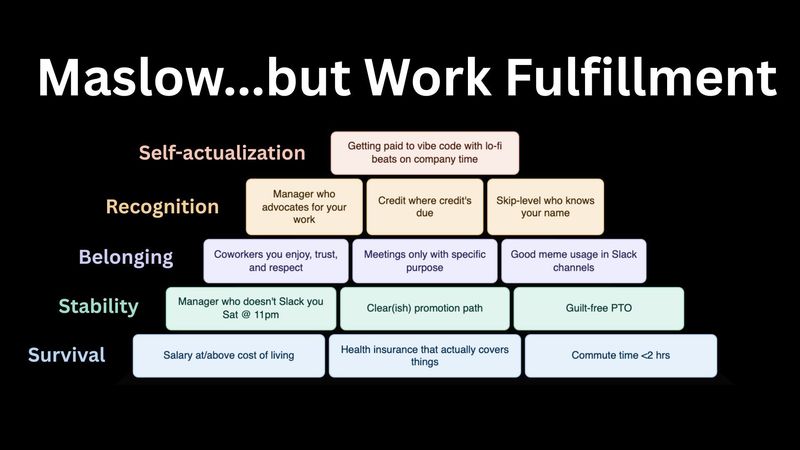
In a world where some of your basic needs are met, people are motivated by what works to deliver. I, for one, have always struggled while working in corporations where the pace of change is slow, access to tools is outdated and any meaningful change is stuck behind layers of corporate politics and policy permissions that might never see the light of day.
My brother works for one such large corporation, and it takes him ages to deploy any of the latest AI tools that I keep suggesting to him. Let alone make a meaningful impact at work. Sometimes, permission lags behind adoptions: employees are already using software outside of the company laptop or finding a way to sidestep such restrictions.
I thrive best where I am given room and freedom to experiment. This, for me, now means AI-native, or at least AI-curious, organizations that are emerging. I appreciate the short cycle time between learning a new, niche application of AI and building a personal workflow using the latest AI tool.
Rise of the CEO > Members of Technical Staff (MTS)
One trend we are seeing is that more C-suite executives are switching out to roles at one of the frontier labs because with ith AI, an IC can have 20x impact at a frontier lab than being a C-suite executive at a company still adapting to the speed of AI.
AI-native software engineering teams are already a thing.